
Collar & Product Guides
Why the Two-Finger Rule Isn’t the Best Way to Size a Dog Collar
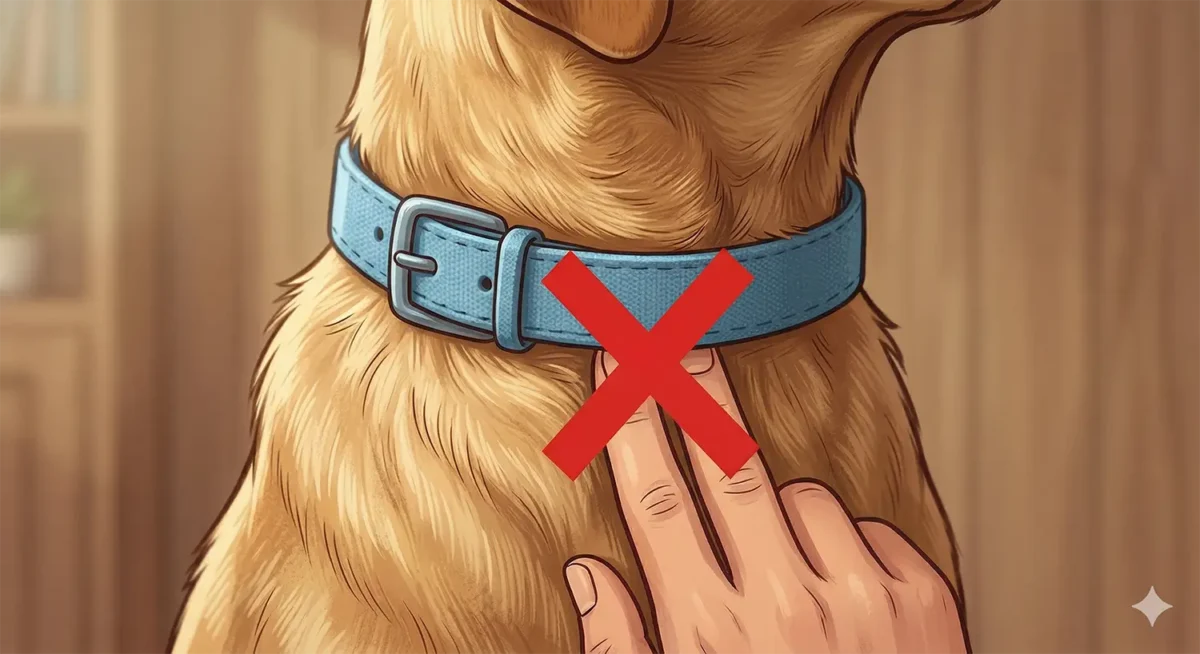
The two-finger rule is everywhere. It’s referenced over and over again on social media, it’s on most pet retailer websites, and it gets passed around dog owner groups as though it’s settled fact. Slide two fingers under your dog’s collar and if they fit, the collar fits. Simple, quick, and almost universally recommended.
The problem is that it isn’t one method. Ask different people to show you the two-finger rule and you’ll get different techniques. Two fingers pressed together side by side. Two fingers held apart in a V. Two fingers stacked on top of each other. Each produces a different gap, and none of them gives you a number you can actually use to order a collar with confidence.
What is the Two-Finger Rule for Dog Collar Sizing?
The two-finger rule is a fit check, not a measuring method. Once a collar is on your dog, you slide two fingers underneath it to check whether there’s enough room. If your fingers fit comfortably, the thinking goes, the collar is neither too tight nor too loose.
As a rough check on a collar that’s already fitted, it has some merit. The issue is that it has become the default advice for sizing a collar before buying one, and for that purpose it doesn’t hold up. You can’t order a made-to-order collar based on how many fingers fit under your current one, particularly when the gap those fingers create varies by an inch or more depending on whose hands are doing the checking and which version of the rule they’re using.
How to Measure Your Dog’s Neck for a Collar
A soft tape measure gives you a precise, repeatable number that doesn’t change depending on hand size or technique. Measure around the middle of your dog’s neck with the tape touching the fur, not pulled tight and not sitting above the coat. Note the measurement in inches.
When choosing a size, find the range where your measurement falls at or just above the lower number. A dog measuring 12.5 inches fits a 12 to 14 inch collar, for example. That puts the neck at the smaller end of the adjustment range so the fit can be set exactly where it needs to be once the collar arrives.
Every Petiquette collar is made to order from that measurement. Not from a rough estimate, not from a finger-width approximation, but from the actual size of your dog’s neck in inches. If you’re ever unsure which size is right, get in touch before ordering and we’ll work it out with you.
Use our size guide hub to find the right measuring guide for your collar style.
How to Measure a Sighthound for a Collar
Greyhounds, whippets, lurchers and Italian greyhounds need a slightly different approach. Sighthounds have narrow skulls relative to the width of their necks, which means a collar sized to the neck alone can slide forward and over the head when the dog pulls back or dips low.
For sighthounds, measure the narrowest part of the neck, just behind the ears and under the chin. This is the point the collar needs to clear to stay on, so it’s the measurement that matters, not the widest part of the neck.
What if My Dog Falls Between Collar Sizes?
It happens regularly. If your dog’s measurement sits at the top of one size range or the very bottom of the next and you’re not sure which way to go, just ask. We make every collar by hand in our Northumberland workshop, and if the standard size range doesn’t serve your dog well, we’ll make one that does. The collar should fit the dog, and that’s always going to matter more to us than keeping to a rigid size chart.
Frequently Asked Questions
Is the two-finger rule a reliable way to measure a dog for a collar?
As a quick check on a collar that’s already fitted, it can give you a rough sense of whether there’s enough room. As a method for sizing a collar before buying, it’s less reliable, because the gap it creates varies significantly depending on hand size and which version of the rule is being used. A tape measure gives you a consistent number regardless of who’s doing the measuring.
How do I measure my dog’s neck for a collar?
Use a soft tape measure around the middle of the neck with the tape touching the fur. Choose the size where your measurement falls at or just above the lowest number in the range. A 12.5 inch neck, for example, fits a 12 to 14 inch collar.
How do I measure a greyhound or whippet for a collar?
Measure the narrowest part of the neck, behind the ears and under the chin. This is the point the collar needs to clear to stay on, making it the correct measuring point for sighthound breeds.
What if my dog is between sizes?
Get in touch before ordering. If your measurement falls awkwardly between two sizes we can make a collar to the exact measurement needed.
Do all Petiquette collar styles use the same measuring method?
The tape measure method is consistent across all styles, but the measuring point varies. Sighthound collars are measured at the narrowest point of the neck. Our size guide hub has a dedicated guide for each collar style.
Getting the size right before a collar is made is always going to give you a better result than checking the fit of one that wasn’t sized accurately to begin with. A tape measure takes thirty seconds and gives you a number you can rely on.